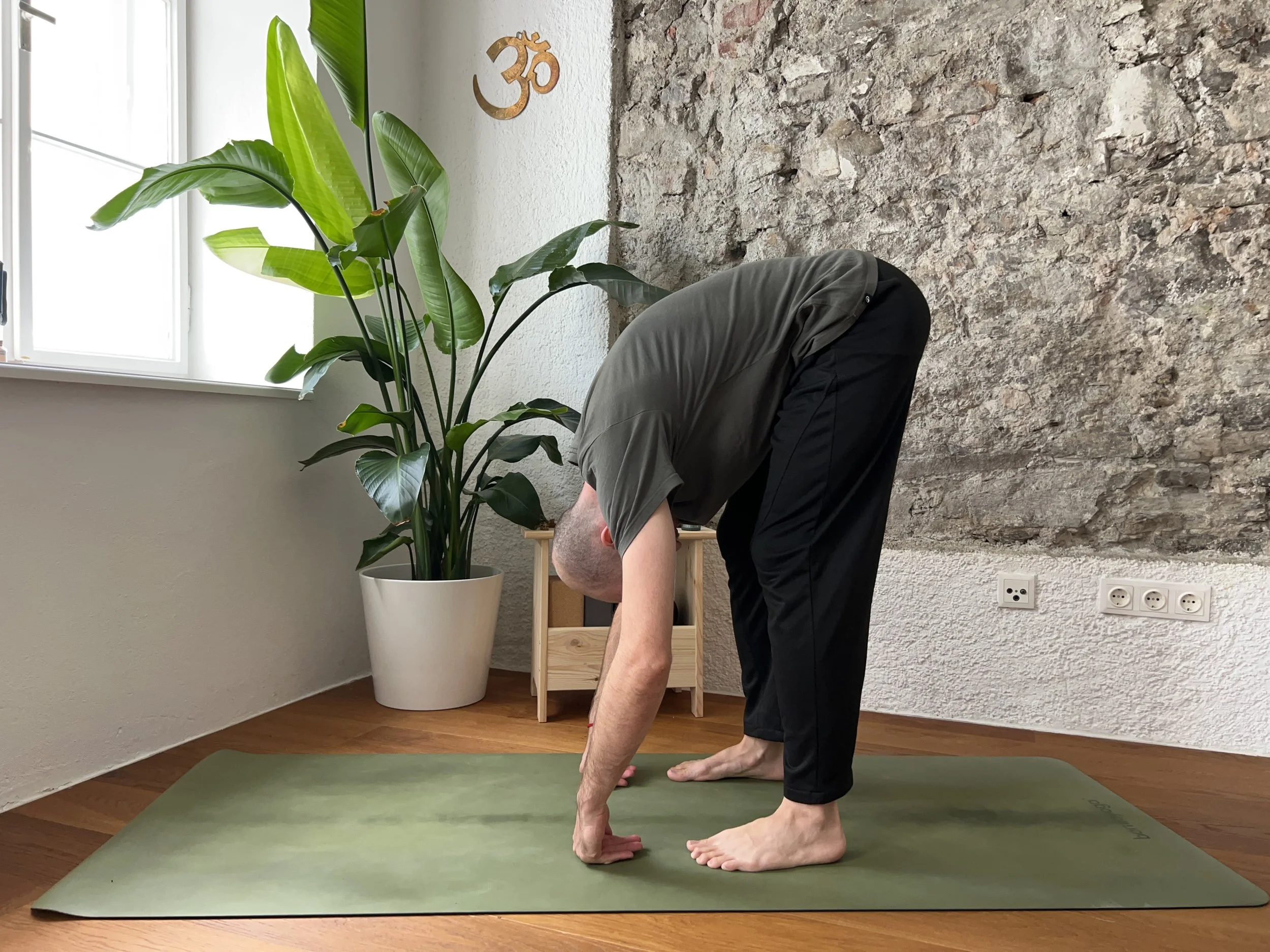
Hangman Pose – a moment to slow down
Hangman Pose is a simple standing forward fold that allows the head, neck and upper body to become heavy while the spine gently lengthens toward the floor.
As an inversion, even though the body remains standing, Hangman can create a quieting effect and offer a moment to slow down. It can be particularly soothing when we feel mentally busy or overwhelmed.
Benefits of Hangman Pose
Hangman creates a gentle stretch through the lower back and the posterior side of the body.
Because the diaphragm is involved in breathing and the abdominal contents shift with the forward fold, the posture can also invite a slower, more conscious breath.
In Yin Yoga, Hangman can help to:
Gently stretch and lengthen the lower back
Encourage diaphragmatic breathing
Slow the breath and support a calmer state
Create a sense of grounding and relaxation
Potentially ease tension associated with the menstrual cycle
The forward fold can be particularly helpful when we want to step away from constant stimulation and give the nervous system a chance to settle.
Meridians & organs
Hangman primarily stimulates the Urinary Bladder meridian, which runs along the posterior side of the body.
Depending on the depth of the fold, there may also be gentle compression through the abdomen, which can create pressure around the abdominal organs.
Some people may also experience sensation around the kidney area, although this will vary depending on individual anatomy and the exact shape of the posture.
Joints involved
The primary joint involved in Hangman is the spine, which moves into flexion.
The knees can remain bent throughout the posture. In fact, bending the knees is often helpful for reducing strain in the lower back and allowing the upper body to relax more fully.
How to enter Hangman Pose
Begin standing with your feet comfortably apart.
Bend your knees and slowly fold your upper body forward.
Allow your head and arms to become heavy. Rather than actively pulling yourself toward the floor, let gravity create the sensation of length through the spine.
You can keep the knees generously bent and allow the torso to rest against the thighs if that feels more comfortable.
Stay for around 2–3 minutes, breathing slowly and allowing the body to soften.
Variations & support
There are several ways to make Hangman more supportive.
You can hold opposite elbows and let the arms hang toward the floor. If your upper body feels heavy, you can gently rest your forearms on your thighs or knees.
For additional support, place your hands or elbows on blocks in front of you. This reduces the amount of weight hanging through the spine and can make the posture more accessible.
The knees can remain deeply bent throughout. There is no need to straighten the legs to make the pose "deeper."
When to be careful
Because Hangman is a mild inversion, it may not be appropriate for everyone.
Take particular care or avoid the posture if you have high blood pressure, glaucoma, diabetes, headaches or migraines, unless you have been advised that inversions are appropriate for you.
If you have existing lower-back problems, keep the knees bent and use plenty of support, or choose another posture.
Come out of the pose if you experience dizziness, pressure in the head, sharp pain or any sensation that feels wrong for your body.
Letting gravity do the work
Hangman is a beautiful reminder that we don't always need to actively stretch.
Once the knees soften and the head becomes heavy, gravity can take over. The spine lengthens, the breath becomes quieter and the mind has an opportunity to slow down.
Instead of reaching for the floor, simply hang.