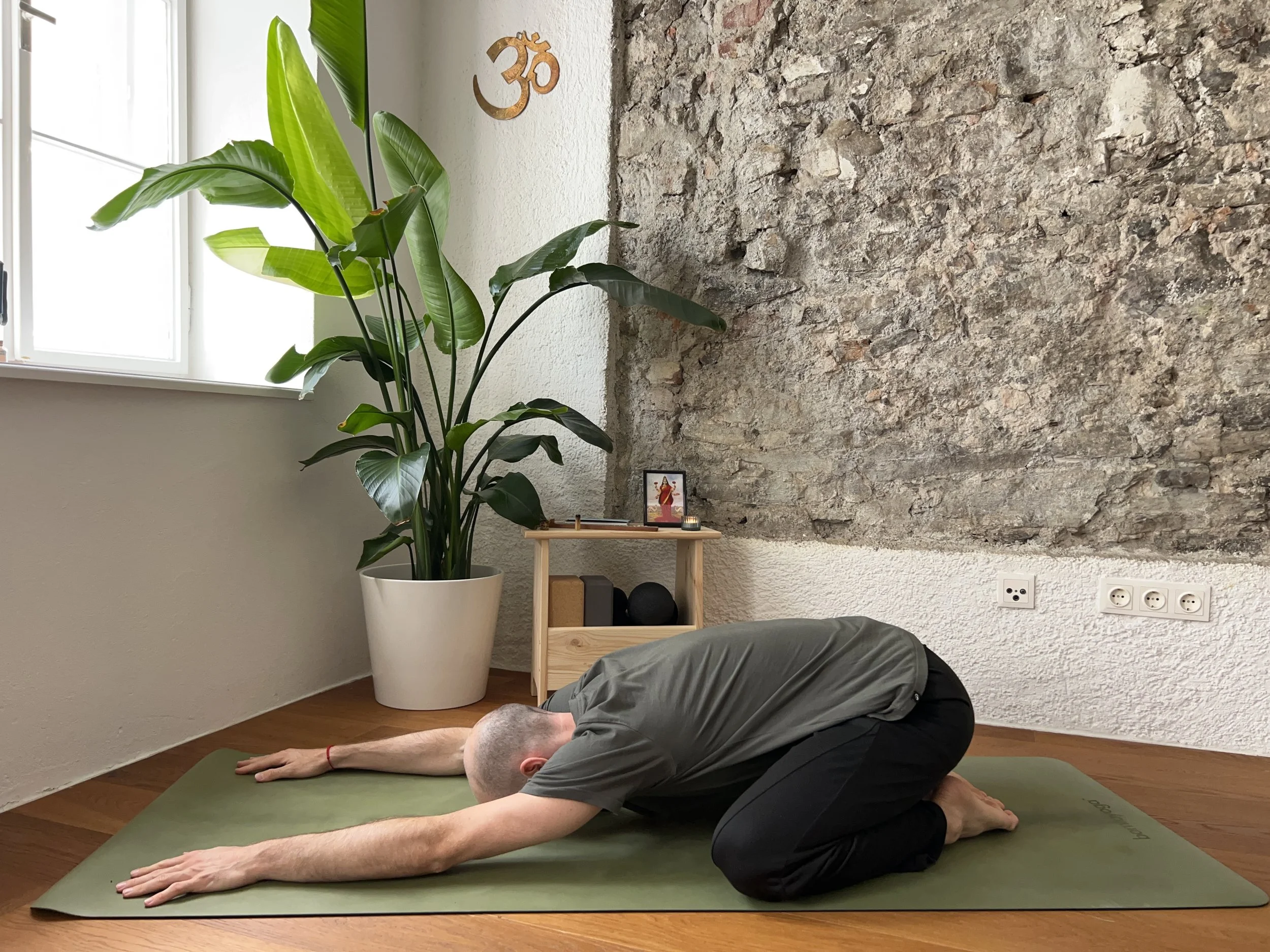
Childe’s Pose – entering your safe space
Child’s Pose, or Balasana, is one of the most familiar and comforting shapes in yoga. In Yin Yoga, we can use it as a gentle forward fold that stretches the back body while creating a soft compression through the abdomen.
It is a simple posture, but one that can invite a strong sense of turning inward, slowing down and settling.
Benefits of Child’s Pose
Child’s Pose creates a gentle stretch through the back and spine without requiring much muscular effort.
The forward fold also creates soft compression around the abdomen, which in the context of Traditional Chinese Medicine is associated with stimulation of the digestive organs.
In Yin Yoga, Child’s Pose can help to:
Gently stretch and soften the back
Create compression through the abdomen
Stimulate the digestive organs
Encourage relaxation and a calmer state of mind
Create a sense of safety and inwardness
Because the forehead is supported by the floor or a prop, the posture can also feel particularly grounding and restful.
Meridians & organs
Child’s Pose primarily affects the Urinary Bladder and Stomach meridians.
The back body is gently lengthened, stimulating the pathway of the Urinary Bladder meridian, while the soft compression through the front of the body relates to the Stomach meridian.
The abdominal compression can also create gentle pressure around the digestive organs.
Joints involved
The main joints involved are the spine, hips and knees.
The hips move into flexion as the torso folds forward, while the knees remain deeply bent.
As with all Yin Yoga postures, the shape will look different depending on your anatomy and mobility. There is no need to force the hips toward the heels.
How to enter Child’s Pose
Begin kneeling with your hips resting toward your heels.
From here, slowly fold your upper body forward, allowing your belly to move toward your thighs and your forehead toward the floor.
You can extend your arms forward or let them rest alongside your body.
Once you have found a comfortable position, allow your shoulders, arms and back to soften.
Stay for around 3–5 minutes, breathing slowly and allowing the posture to become increasingly restful.
Making Child’s Pose more comfortable
If the position feels uncomfortable around the knees or hips, props can make a big difference.
Place a folded blanket between your calves and thighs or underneath your ankles for additional support.
You can also place a bolster underneath your chest and head, allowing your entire upper body to rest.
If your forehead doesn't comfortably reach the floor, use a block, cushion or bolster underneath the head rather than straining the neck.
When to be careful
Child’s Pose may not be appropriate if you are experiencing diarrhea, as the abdominal compression may be uncomfortable.
During pregnancy, the traditional closed-knee version can create too much compression through the abdomen. Choose a wider-knee variation with appropriate support, or another posture, depending on your stage of pregnancy and individual needs.
If you have knee problems, modify the posture generously or choose an alternative.
As always, distinguish between a gentle sensation of stretching or compression and pain. The posture should allow you to breathe comfortably and relax rather than force your body into a particular shape.
Coming home to yourself
There is something naturally calming about Child’s Pose. The body folds inward, the back rounds and the head becomes supported.
In Yin Yoga, this can become an invitation to do less — to stop holding, striving and moving, and simply allow yourself to be supported.
Sometimes a simple posture is exactly what we need to come back to ourselves.