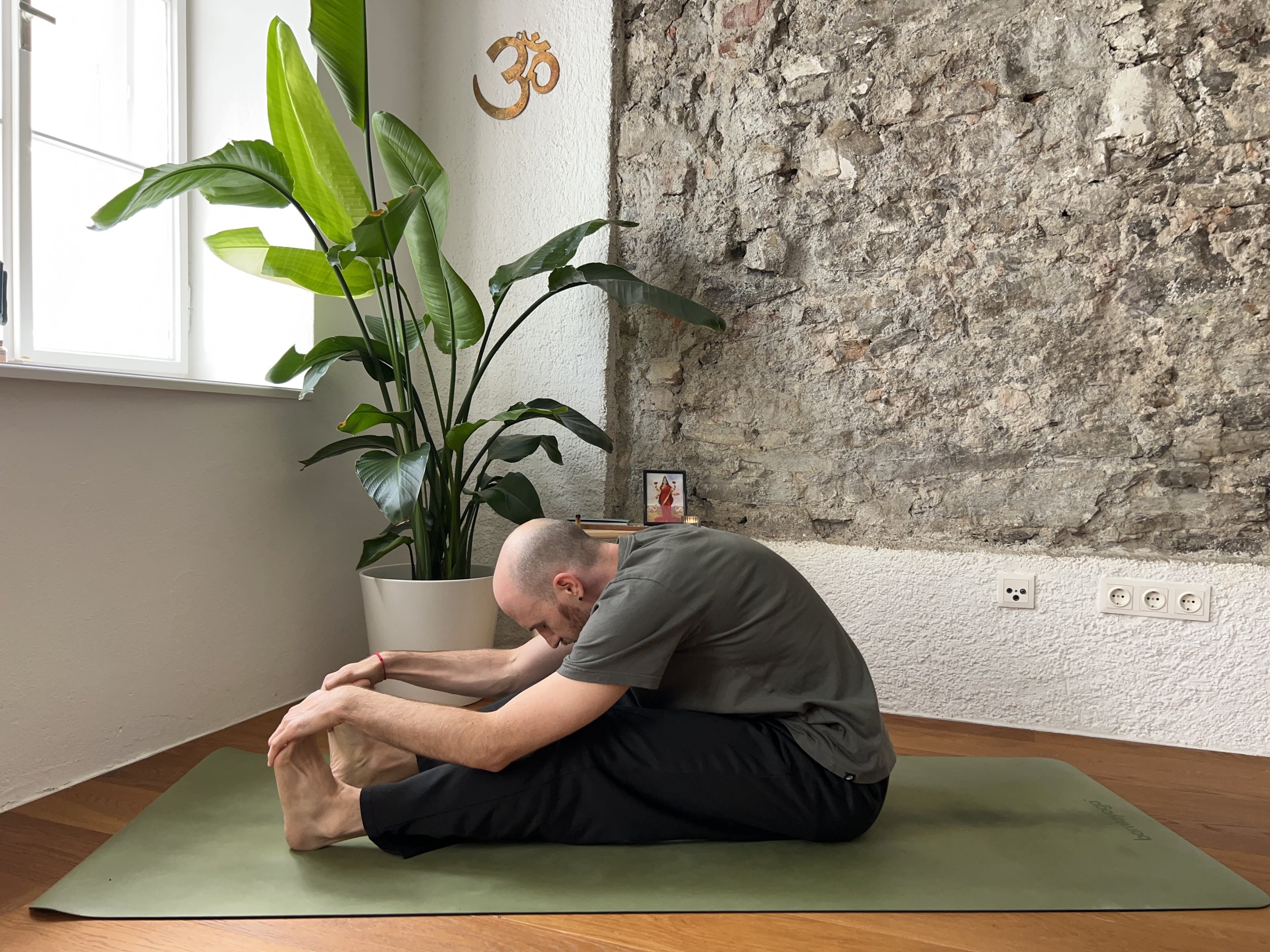
Gently folding forward in Caterpillar Pose
Caterpillar Pose is the Yin Yoga version of a seated forward fold. Unlike the more active versions of a forward fold, the Yin approach invites us to let go of muscular effort and allow the spine to gradually round.
This creates a long stretch through the entire back body and offers a quiet opportunity to turn inward, slow down and surrender to gravity.
Benefits of Caterpillar Pose
Caterpillar stretches the entire posterior chain of the body, including the back, hamstrings and calves.
As the spine rounds forward, the posture creates gentle tension through the tissues surrounding the spine while lengthening the back of the legs.
In Yin Yoga, Caterpillar can help to:
Stretch the entire back body
Create gentle tension through the spine
Lengthen the hamstrings and calves
Release muscular effort through the back and legs
Encourage a feeling of turning inward and letting go
Rather than trying to keep the spine straight, the Yin version intentionally allows the back to round. The aim is not to reach the feet, but to find a sustainable position where the body can gradually soften.
Meridians & organs
Caterpillar primarily stimulates the Urinary Bladder meridian, which runs along the posterior side of the body.
The forward fold also creates compression through the abdomen. Depending on the individual shape and how deeply you fold, this can create gentle compression around the abdominal organs.
Joints involved
The main joints involved are the spine and hips.
The hips move into flexion while the spine gradually rounds into flexion.
The amount of movement available in these areas will vary considerably from person to person. A rounded spine is not inherently a problem in this posture — it is part of the Yin approach to the shape.
How to enter Caterpillar Pose
Begin seated with your legs extended comfortably in front of you.
Allow your knees to soften and slowly fold forward from the hips.
Rather than trying to keep your spine long, allow the spine to round naturally. Let your head become heavy and allow your arms and hands to relax toward the floor, your legs or your feet.
Once you have found your edge, stop actively pulling yourself forward.
Let gravity gradually do the work.
Stay for around 3–5 minutes, breathing slowly and allowing the entire back body to soften.
Making the posture more accessible
There are many ways to support yourself in Caterpillar.
If your hips or lower back feel tight, sit on a cushion or folded blanket to elevate your pelvis.
If your hamstrings are particularly tight or you feel too much sensation in your lower back, bend your knees. You can place a bolster or folded blanket underneath the knees so the legs can fully relax.
You can also place a bolster underneath your chest and allow your upper body to rest on it. Alternatively, support your forehead with a block or cushion.
Another option is to hug your knees rather than reaching toward your feet. This can create a more contained and restful version of the posture.
When to be careful
Caterpillar may not be appropriate if you have sciatica or certain lower-back conditions, as forward flexion can sometimes aggravate symptoms.
If you have a sensitive lower back, keep the knees bent and use plenty of support.
Tight hamstrings can also make the posture feel particularly intense. Rather than forcing the legs straight, allow the knees to bend and work with your current range of motion.
Sharp or radiating pain is a sign to come out of the posture or change the variation.
The Yin version of a forward fold
In many active yoga practices, forward folds are approached with an emphasis on lengthening the spine and engaging the legs.
Caterpillar offers something different.
Here, we allow the spine to round, the head to become heavy and the muscles to soften. It is less about creating the perfect shape and more about letting go of effort.
Sometimes the most valuable part of the practice is simply learning that we don't have to hold ourselves up all the time.