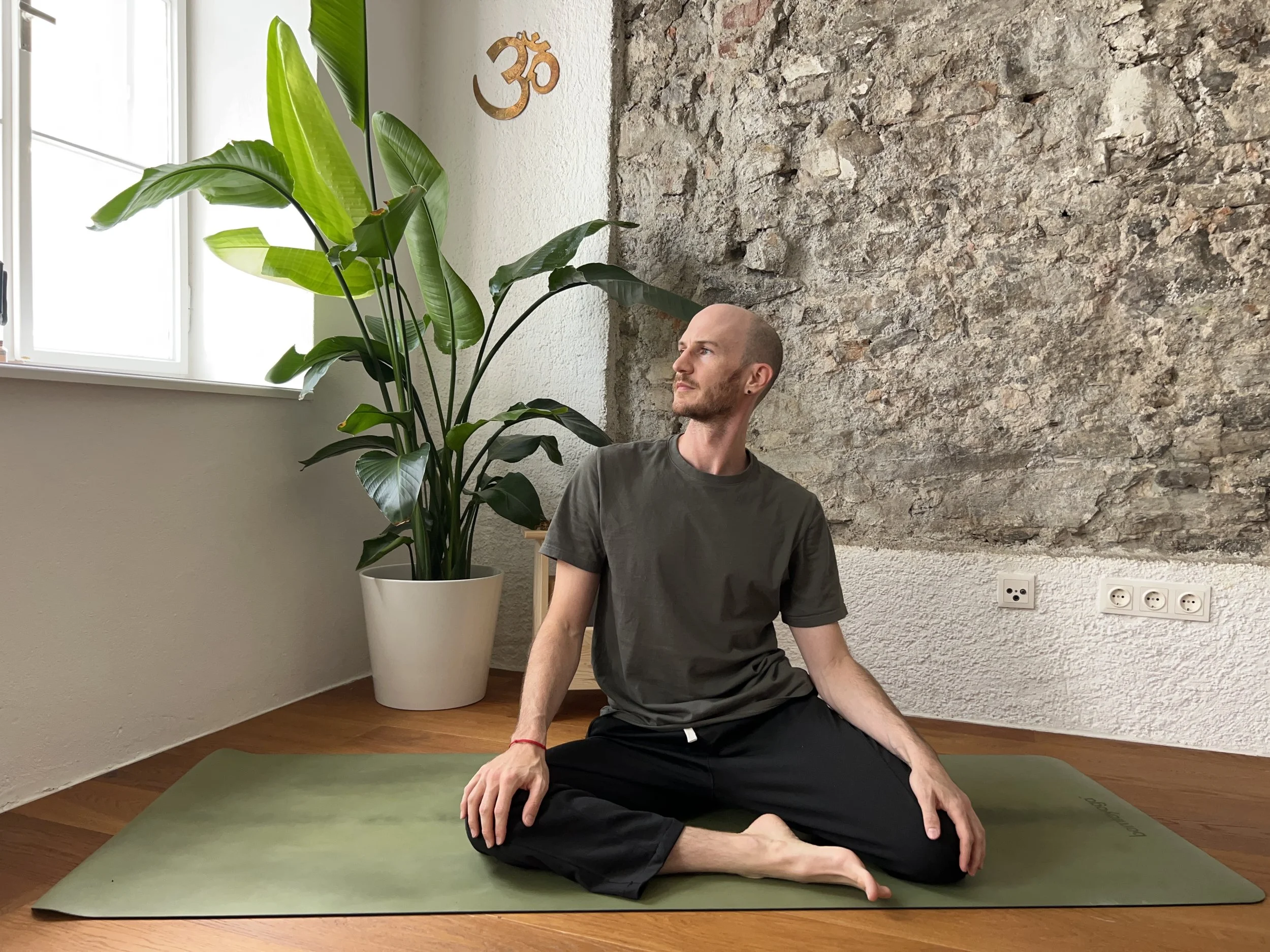
Deer Pose – opening the hips
Deer Pose is a beautiful Yin Yoga posture for exploring the different movements available in the hips. With one leg rotated outward in front of you and the other rotated inward behind you, the pose creates an interesting and often very pleasant sensation of rotation through the hips.
It can be a wonderful alternative to more symmetrical hip openers and offers several ways to explore the posture depending on what your body needs that day.
Benefits of Deer Pose
Deer Pose creates a gentle external rotation in the front hip and internal rotation in the back hip.
This asymmetry allows us to experience the hips in two different positions at the same time and can create a subtle sense of space and mobility around the hip joints.
In Yin Yoga, Deer can help to:
Explore external rotation in one hip
Explore internal rotation in the opposite hip
Create a gentle opening through the hips
Release tension around the hips and pelvis
Offer a different perspective on hip mobility
The shape can also be combined with a twist or forward fold to explore different areas of the body.
Meridians & organs
Deer Pose can stimulate several meridian pathways associated with the legs and hips, including the Gallbladder, Liver, Kidney, Spleen and Stomach meridians.
If you add a twist, the rotation and compression through the abdomen can also create gentle pressure around the abdominal organs.
Joints involved
The main joints involved are the hips, knees and spine.
The front leg is in external rotation while the back leg is in internal rotation. The spine can remain upright, rotate into a twist or fold forward depending on the variation.
Because the hips and knees are placed asymmetrically, it is especially important to pay attention to how the posture feels rather than trying to reproduce a particular shape.
How to enter Deer Pose
Begin seated in Butterfly Pose, with the soles of your feet together and your knees falling out to the sides.
From here, allow one leg to stay in front of you while you gently move the other leg behind you, bending the back knee.
Let both legs become heavy and settle toward the floor.
You can keep your torso upright or begin to explore one of the variations below.
Stay for around 3–5 minutes, then slowly change sides.
Deer Pose Variations
There are several ways to explore Deer Pose.
Deer Twist
From the upright position, gently rotate your torso toward the front leg. Move slowly and allow the rotation to come primarily from the spine rather than forcing the movement.
Deer Forward Fold
You can also fold forward over the front leg, allowing the upper body to become heavy and relaxed.
Using props
Depending on your anatomy, one or both hips may not naturally reach the floor. Place a folded blanket or blocks underneath the hips or knees to create more support.
The aim is to allow both sides of the pelvis and the legs to feel supported rather than forcing the thighs toward the floor.
When to be careful
Take care with Deer Pose if you have existing knee or hip problems.
The asymmetrical position can create significant rotation through the hips and knees, so never force the legs into position.
If you feel pressure or pain in the knee, adjust the position of the leg or add more support. The sensation should primarily be experienced around the hips rather than as sharp or uncomfortable pressure in the knees.
As always, props are not a sign that you are doing less. They allow you to find a version of the posture that works with your individual anatomy.
Exploring the hips
One of the beautiful things about Deer is that it reminds us that our two hips don't have to do the same thing.
One is externally rotating while the other is internally rotating. Rather than searching for symmetry, we can become curious about the different sensations on each side.
Yin Yoga gives us the time to notice these differences — without needing to change or fix them.