Yin Yoga Focus: Anahatasana (Melting Heart Pose)
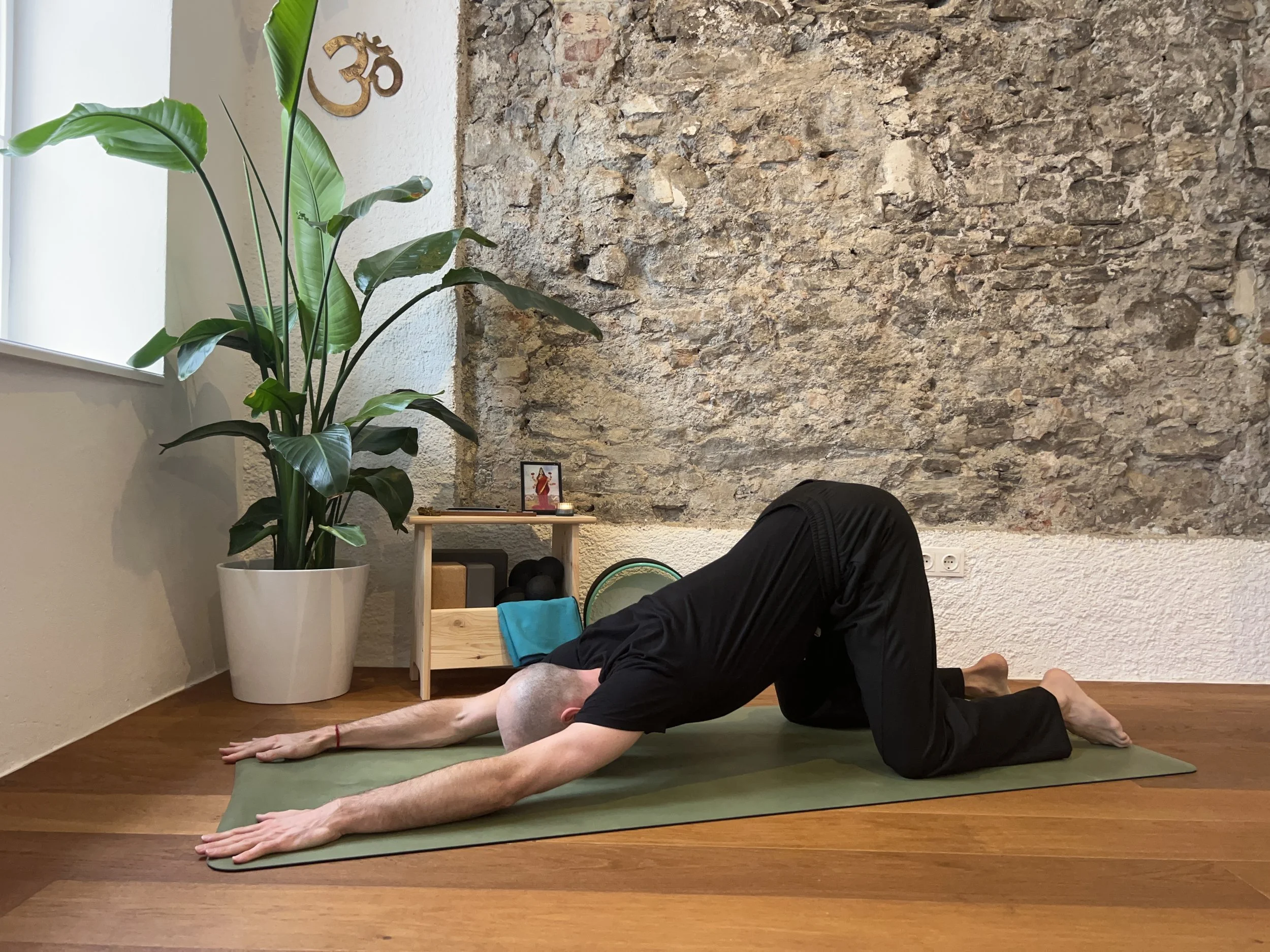
Anahatasana, sometimes called Melting Heart Pose or Disciple Pose, is a beautiful Yin Yoga posture for opening the shoulders, chest and upper back.
The Sanskrit name comes from anahata, the heart chakra. And the name captures the quality of the pose beautifully: as the chest melts toward the earth, we create space around the heart and practise softening rather than pushing.
Benefits of Anahatasana
Anahatasana brings the spine into extension, with a particular emphasis on the thoracic spine, or upper and middle back.
This makes it a wonderful counterpose to the rounded posture many of us spend hours in every day — sitting at a desk, looking at our phones or working on a computer.
In Yin Yoga, Anahatasana can help to:
Create extension through the thoracic spine
Open the shoulders and chest
Stretch the arms and armpits
Counterbalance rounded, forward-facing posture
Create more space around the ribcage and breath
Encourage a feeling of openness and softness around the heart
Rather than trying to bring the chest as close to the floor as possible, think of the pose as an opportunity to gradually create space across the entire upper body.
Meridians & organs
Anahatasana can stimulate the Heart and Lung meridians, particularly through the opening of the chest and the stretch along the inner arms.
The compression and extension through the middle and upper back can also influence the Urinary Bladder meridian, which runs along either side of the spine.
Through these energetic pathways, the pose is associated with the heart and lungs, as well as the Spleen and Stomach within the framework of Traditional Chinese Medicine.
Joints involved
The two main areas affected by Anahatasana are the spine and shoulders.
Spine: The thoracic spine moves into extension while the lower back can remain relatively neutral.
Shoulders: The arms move overhead into flexion, creating a potentially deep opening through the shoulders, chest and armpits.
Because everyone's shoulder and spinal anatomy is different, the final shape of the pose can vary considerably from person to person.
How to enter Anahatasana
Begin on all fours with your hips above your knees.
Keeping your hips approximately over your knees, slowly begin to walk your hands forward.
Continue until you reach a place where you feel a clear but manageable opening through the shoulders, chest and upper back.
Allow your chest to soften toward the mat. Depending on your mobility, your forehead, chin or chest may move toward the floor — but reaching the floor is not the goal.
Once you have found your position, allow as much muscular effort as possible to soften.
Making the pose softer — or more intense
If the pose feels too deep, place a bolster or block underneath your forehead. This can be especially helpful if allowing the head to hang creates tension in the neck.
You can also place a bolster underneath the chest for a more supported variation.
If you would like to explore a stronger opening through the shoulders, place blocks underneath your elbows, bend your arms and bring your hands toward each other or behind your head. This can significantly increase the intensity, so approach this variation gradually.
When to be careful
Anahatasana can be a surprisingly intense posture.
If you have existing neck, shoulder or spinal issues, the depth of the pose may not be appropriate for you. Use props generously, reduce the range of movement or choose another posture if you experience pain, pinching, numbness or tingling.
Especially in Yin Yoga, deeper isn't necessarily better. The intention is to find an appropriate amount of sensation that you can stay with without forcing the body.
Softening the heart
Anahatasana is sometimes translated as Melting Heart Pose, and there is something particularly beautiful about approaching it with this image in mind.
The posture asks us to remain supported through the legs while allowing the chest to descend and the front of the body to become more vulnerable and open.
Instead of actively pulling ourselves deeper, we wait.
With time, gravity and breath, there may be a little more space — through the shoulders, through the upper back, and perhaps around the heart itself.